
The Patt. 152 and the Post‑War Strand Effects‑Projection Lineage Preserved at HSLC
This article explores the Strand Patt. 152 scenic and effects projector and the wider post‑war lineage it belongs to — from the Patt. 52 through to the Cadenza EP — now preserved at HSLC alongside the National Theatre’s complete effects‑disc archive.
EFFECTS PROJECTOR
Ian Lewis
8 min read
The Patt. 152 and the Post‑War Strand Effects‑Projection Lineage at HSLC
How HSLC became the custodian of Britain’s scenic and atmospheric projection heritage
For some of the 19th and all of the 20th century, long before digital projection and moving lights reshaped the stage, atmospheric movement was created by a quieter, more analogue kind of magic. Within living memory, Strand Electric’s scenic and effects projectors — from early carbon‑arc lanterns to later high‑power tungsten and tungsten‑halogen machines — produced drifting clouds, rippling water, flickering fire, and textured motion that shaped the visual language of British theatre, opera, and television.
Several of these projectors evolved significantly during their production lives. HSLC documentation reflects both original design intent and later standardised practice, preserving not just the equipment itself but the thinking that shaped it.
Today, HSLC preserves the most complete surviving post‑war lineage of Strand effects projectors anywhere in the UK. The collection includes the Patt. 52, Patt. 152, Patt. 252, Patt. 752 and Cadenza EP, alongside the National Theatre’s entire effects‑disc archive. Our interest began with a gift of a Patt. 152 from the Philip Edwards Collection, but research quickly revealed something much larger: a continuous chain of people, ideas, and equipment that HSLC now stewards as living heritage for the future.
Before the Patt. 152
The origins of effects projection
Strand Electric’s effects‑projection story begins in 1925 with the Patt. 33, a carbon‑arc effects projector designed to project rotating painted glass effects discs. These discs — often hand‑painted and individually distinctive — created moving images of clouds, fire, water, rain, snow, and abstract textures.
The basic format of a rotating effects disc projected through a front objective lens is believed to have been standardised before the First World War, most notably by the Kliegl Brothers Universal Electric Stage Lighting Company, founded in New York in 1896 by Johann and Anton Kliegl. Their system became a de facto international standard, adopted and refined by Strand and others for more than a century. Early effects discs were painted mica driven by clockwork; the last were DMX‑controlled glass discs. Eddie Biddle, Strand’s in‑house specialist, devised many bespoke examples — several of which HSLC plans to exhibit.
Although HSLC does not hold the earliest carbon‑arc models, we preserve the complete post‑war evolution that followed them. We also hold several working carbon‑arc lanterns that help interpret the light source itself — the CSI or HMI of its day. It is this period that defined the mature language of scenic and atmospheric projection.
The Patt. 51 and Patt. 52
The first modern tungsten effects projectors
Strand’s first tungsten effects projector was the 1936 Patt. 51, which introduced prefocus lamp holders and marked the transition from carbon‑arc to tungsten incandescent projection.
This was followed by the Patt. 52, introduced in the late 1940s. The Patt. 52 used a 1 kW non‑halogen tungsten incandescent lamp with a condenser‑based optical system, offering improved practicality and reliability. It became a familiar sight in repertory theatres and early television studios, typically operated by technicians who understood its behaviour intimately — adjusting disc speed, focus, and shuttering to create subtle atmospheric movement rather than overt spectacle.
HSLC holds several examples of the Patt. 52, including a rare foreshortened version from the Royal Opera House — a shortened‑body variant adapted to fit into confined scenic spaces such as fireplaces.
The Patt. 152
Strand’s 4 kW flagship — and the centrepiece of the story
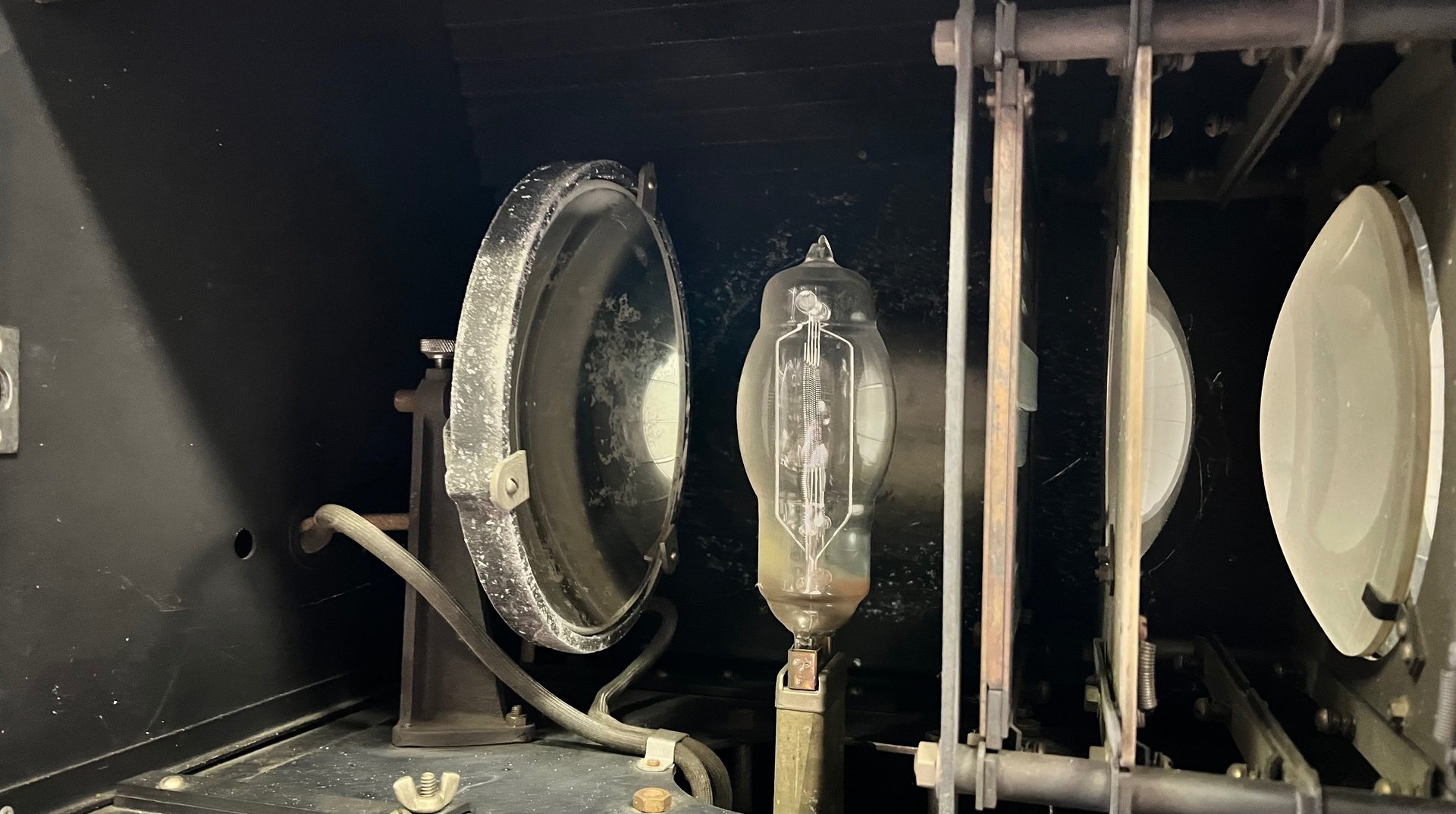
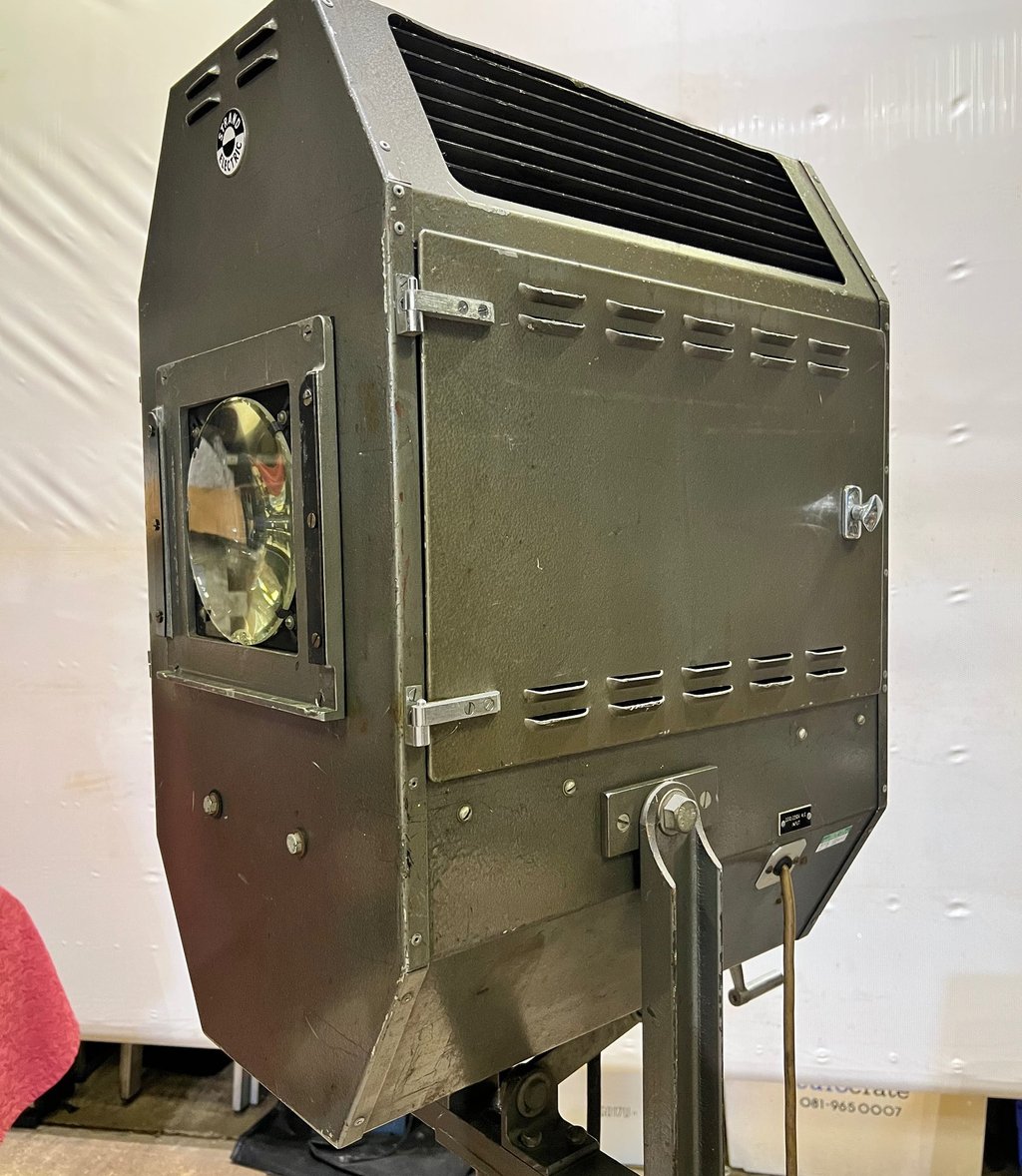
Introduced in 1959, the Strand Patt. 152 was a true powerhouse: a 4 kW high‑intensity scenic and effects projector designed for opera houses, large theatres, and the rapidly expanding world of television production.
It employed a 4 kW non‑halogen tungsten incandescent tubular projection lamp, mounted in a G38 lamp holder, combined with:
· a four‑element condenser system
· a 7‑inch spherical glass reflector
· multiple layers of heat‑absorbing glass
· forced internal cooling
The Patt. 152 was not simply brighter than its predecessors — it had presence. Operators recall the heat it produced, the low mechanical hum, and the way its beam seemed to carve through haze. It was a lantern that demanded experience and rewarded skill.
Strand documentation distinguishes between the Patt. 152 (stand‑mounted) and Patt. 152/H (hanging) variants. Both share identical optical and lamp systems, differing only in mounting hardware and intended installation.
Effects projectors such as the Patt. 152 were used extensively by the National Theatre during its Old Vic years (1963–1976) and continued into the early years of the South Bank building. Documented use also includes cyclorama projection at the Royal Opera House, where the Patt. 152 was employed in major operatic productions, including Midsummer Marriage.
HSLC preserves the Patt. 152 as a central object in the collection and a key reference point in British stage‑lighting history. We believe our examples originated from Nottingham Playhouse, a pioneer of scenic projection.
The Patt. 752
Strand’s large‑format scenic projector
Introduced in the early 1970s, the Patt. 752 was a high‑power scenic projector closely related to the Patt. 152 but designed primarily for large‑format slide projection. It employed the same 4 kW 110 V lamp but used a 10‑inch, four‑element condenser system, allowing it to project 7‑inch and 5‑inch scenic slides with exceptional brightness and clarity.
The Patt. 752 was supplied with:
· a carrier for large scenic slides
· serrated shutter combs for scenic masking
· mounts for high‑definition Dallmeyer lenses
Crucially, the 1971 Strand catalogue confirms that the Patt. 752 could also accept standard 8‑inch effects‑disc attachments when fitted with its optional alternative front casting. This made it a hybrid: primarily a scenic projector, but capable of participating in the wider effects‑projection ecosystem when required.
HSLC interprets the Patt. 752 as part of the broader Strand scenic‑projection family — a specialised but important branch of the lineage.
The Patt. 252
Flexibility, standardisation, and a transitional design
Introduced in the mid‑1960s, the Patt. 252 occupies a pivotal position in Strand Electric’s effects‑projection lineage. While often described retrospectively as a compact 2 kW successor to the Patt. 152, contemporary Strand documentation reveals a more nuanced intent.
Early Strand catalogues (1965–66) present the Patt. 252 as a flexible effects projector, capable of operating at 1000 W, 1500 W, or 2000 W, depending on voltage, installation, and application. In this form, it replaced the earlier Patt. 52 and served a wide range of theatres, studios, and venues that required atmospheric projection but did not need — or could not accommodate — a 4 kW machine.
Early multi‑wattage operation
Strand’s 1965–66 catalogue lists the Patt. 252 with multiple lamp options, all based on non‑halogen tungsten incandescent technology, including:
· 1000 W lamps (Class A1/188 and equivalents)
· 1500 W lamps (voltage‑dependent)
· 2000 W lamps (Class A1/218 and equivalents)
These lamps used large prefocus lamp holders and were supported by a three‑element condenser system with substantial heat‑absorbing glass and an expansion frame to protect the projected image. This allowed the projector to operate without forced internal cooling, even at higher wattages.
Convergence on 2 kW practice
By the late 1960s and early 1970s, professional practice had largely converged on 2000 W operation, offering the best balance of brightness, reliability, and optical performance.
During this period, the Patt. 252 was increasingly operated with either:
· A1/218 non‑halogen tungsten incandescent lamps, or
· CP/53 tungsten‑halogen lamps, as halogen technology matured
Both lamp types used P40s prefocus bases and were mechanically interchangeable within the lantern.
Later Rank Strand datasheets reflect this standardised 2 kW usage and no longer emphasise the earlier lower‑wattage options. HSLC documentation preserves both phases to reflect the full operational history of the projector.
Objective lenses and optical practice
Effects projectors such as the Patt. 252 employed interchangeable objective lenses mounted at the front of the effects attachment to focus and project the image from the rotating effects disc.
Strand supplied both standard objective lenses for general theatrical use and high‑definition objective lenses manufactured by Dallmeyer, featuring micrometre focusing for improved optical precision.
Standard objective lenses were supplied in focal lengths of 2½ in. (65 mm), 3 in. (75 mm), and 4 in. (100 mm). High‑definition Dallmeyer objective lenses were available in 4 in. (100 mm) and 6 in. (150 mm) focal lengths, both rated at f/1.9.
These objective lenses were shared across multiple effects‑projector models, and HSLC now preserves a number of original examples acquired from the National Theatre, providing direct evidence of how optics were selected and reused to suit specific venues, throws, and productions.
Broadcast divergence — the BBC variant
A small number of Patt. 252 units were produced in a specialised configuration for the BBC. These employed:
· a 1 kW CSI daylight‑balanced discharge lamp
· a five‑element condenser system
· external control gear
These rare units document a divergence driven by broadcast requirements and mark a moment when television lighting was developing its own distinct technical language.
What the Patt. 252 represents
The Patt. 252 is best understood not as a fixed specification, but as a transitional design:
· bridging non‑halogen tungsten and tungsten‑halogen eras
· accommodating multiple wattages before practice stabilised
· refining effects projection into a more compact, manageable form
It became one of the most widely used effects projectors of its time precisely because of this adaptability.
A note on the Patt. 202
Although not part of HSLC’s collection, the Patt. 202 deserves brief mention as an example of Strand Electric’s miniature effects‑projection work. Contemporary Strand literature describes the Patt. 202 as a 250‑watt mini‑effects projector, complete with a built‑in transformer for operation with a 24‑volt tungsten‑halogen (“quartz”) lamp.
While the Patt. 202 made use of the external lamphouse form of the highly successful Strand Pattern 23, originally designed by aircraft engineer Morgan McLeod, it did not retain the Patt. 23 optical system. The original gate and lens tube were removed and replaced with a purpose‑designed small‑format optical assembly and a compact motorised effects mechanism, allowing miniature effects discs to be rotated directly at the front of the lantern.
Strand documentation places the Patt. 202 firmly within the theatrical effects tradition, using miniature optical effects discs to produce both naturalistic moving effects — such as clouds and flames — and a range of colour and abstract effects. Its design reflects Strand’s practice of re‑engineering proven mechanical forms while developing optics and motion systems specifically for new scales and applications.
The Cadenza EP
Refinement without noise
Introduced in 1985, the Cadenza EP marked a decisive move into the tungsten‑halogen era of effects projection. It combined a halogen light source with improved optical efficiency and refined mechanical design, without the use of forced cooling.
In operation, the Cadenza EP is passively cooled and naturally silent, with audible sound limited to the effects motor and rotating effects wheel.
HSLC preserves the Cadenza EP as part of the complete post‑war Strand effects‑projection lineage. Our example came from Philip Edwards’ hire stock.
The Toccata EP
The final and most powerful analogue effects projector
Introduced in 1996, the Toccata EP was the last analogue effects projector Strand ever produced — and the most powerful of the tungsten‑halogen era. Designed for either 2000 W (CP92) or 2500 W (CP91) operation using G22‑base lamps, it employed a three‑element condenser system with heat‑absorbing glass and a quiet assisted‑convection cooling system.
Like the Cadenza EP, it remained naturally silent in operation, with audible sound limited to the effects motor and rotating effects wheel. The Toccata EP could be configured either as a moving‑effects projector or as a large‑format slide projector, using interchangeable objective lenses, a range of effects discs, and optional accessories such as adjustable masks and diverter mirrors.
The Toccata EP marked the final evolution of a lineage that began with carbon‑arc projection in 1925 and ended just before the transition to fully digital systems.
HSLC does not currently hold a Toccata EP, but it remains an important reference point within the wider story interpreted through the rest of the preserved lineage.
The National Theatre Donation (2025)
A complete effects‑projection archive preserved at HSLC
In 2025, the National Theatre donated its entire stock of effects‑projection equipment to HSLC, including rotating effects discs, motorised effects units, optical attachments, objective lenses, condenser lenses, mounting frames, and accessories.
These were not static artefacts. They were working tools used by generations of operators, designers, and technicians. Some discs still carry the fingerprints of the people who painted them. Some motors still hum with the same rhythm they had during the Old Vic years.
This donation forms a direct line of continuity:
Strand Electric → National Theatre → HSLC
It ensures that the craft of atmospheric projection — not just the equipment — survives.
HSLC: A living archive of British moving‑light history
HSLC now preserves:
· the complete post‑war Strand effects‑projection lineage (Patt. 52, 152, 252, 752, Cadenza EP)
· the National Theatre’s entire effects‑disc archive
· thousands of lanterns, dimmers, motors, and accessories
What some might see as storage is, in fact, evidence — the physical record of a century of British lighting history that would otherwise have been lost. HSLC already functions as a national collection in all but name and continues to build the governance, documentation, and public access to match.
This is living heritage, held in trust for the next generation.
For further historical detail, visit the excellent resource at www.theatrecrafts.com/bhc/
© 2026 thehslc.org.uk
© Historic Stage Lighting Collective (HSLC)
All rights reserved.
Contact us